A sovereign, modular platform that collects, processes and certifies terabytes of data and billions of transactions every day. Your own data, not the one reported by the operators. No leakage. No dispute. No excuse.
Modularity
Modular Platform, to handle your priorities
Snype is a modular platform, designed to be deployed according to your priorities. Whether your most pressing need is revenue assurance, fraud detection, mobile money oversight or VAT collection — you start with what matters most, and expand from there.
There is no need to start a new project every time you need a new capability. No new data pipeline, no new integration, no new vendor.
Architecture
One platform, No blind spots.
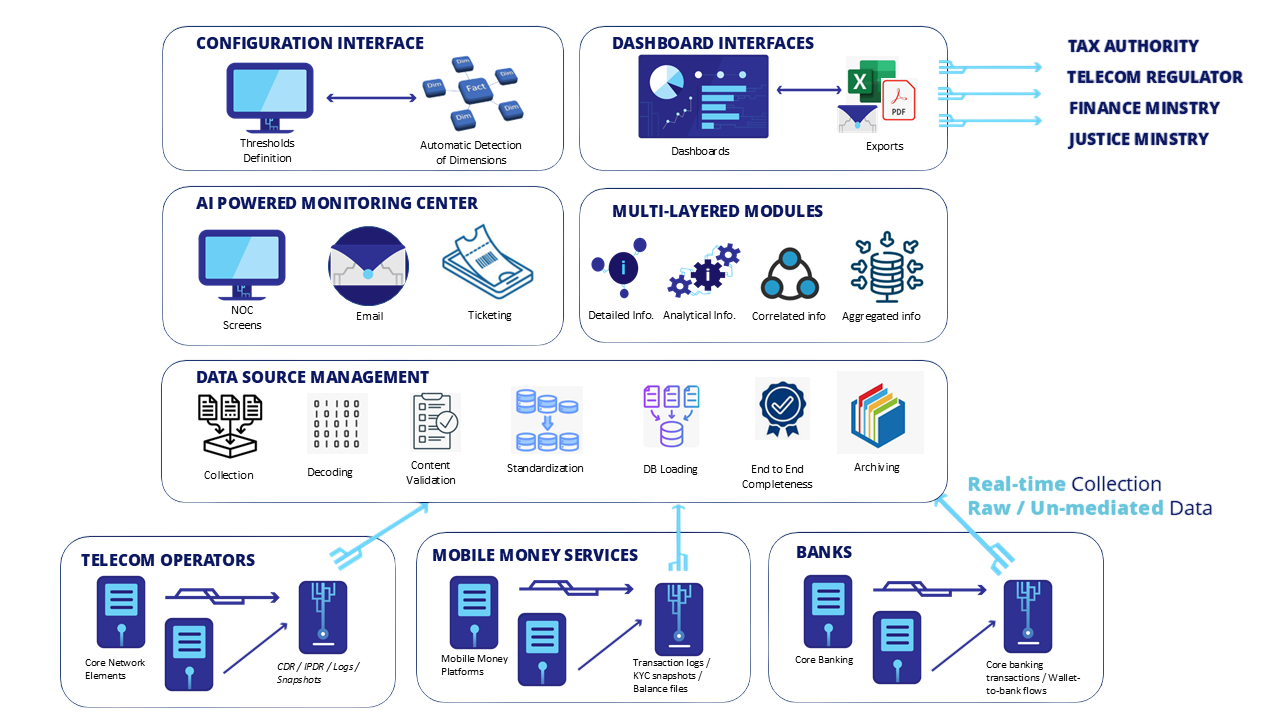
We collect raw, unmediated data directly from every operator's core network and core banking elements, in near real-time. Not the data they report to you. Not pre-processed exports. Not summaries. And we make sure every single file is received, decoded and processed — nothing is left behind.
Each module is built on the same core: one platform, one architecture, one set of operational procedures, one documentation. Only one tool to learn, only one system to trust.
Each module embeds its own quality controls, so you always know you are working with the right data. And each additional module you deploy enriches and reinforces the ones already in place:
The result: end-to-end certified data. No leakage. No blind spot. No dispute.
Each new module doesn't just add new analytics — it strengthens the certification of everything already deployed.
Prepaid & Postpaid revenue modules bring additional controls to Voice, SMS and Data usage
Mobile Money modules bring additional controls to Prepaid & Postpaid top-ups and bundle purchases
Banking modules bring additional controls to Mobile Money bank-to-wallet transactions
And so on — every layer strengthens the whole
Deployment
Public Cloud, Private Cloud, On-premise? Your choice.
Our solution is designed to run wherever your infrastructure and regulatory framework require it. It all depends on your requirements, your constraints, your available infrastructure, and your budget. But the architecture is the same. The modules are the same. The certified data is the same. The choice is yours.
On-premise
Private Cloud
Public Cloud (AWS, Azure, GCP)
Data Sovereignty
Full control. Data never leaves your premises
Depends on cloud location. In-country private cloud ensures sovereignty.
Data may transit or be stored outside the country. Requires specific contractual guarantees.
Security & Access
Physical security under your control. Key-locked racks, IP cameras, full server hardening.
500 TB+ compressed, always queryable. Expandable at hardware cost only.
Private Cloud
Scalable, but storage costs accumulate monthly.
Public Cloud
Per-GB pricing. At 500 TB, storage costs alone can exceed $100K+/year.
Data Collection
We start with what you have. Together, we make it stronger.
All data sources don't bring the same value. We understand every market has its own history. Some regulators have built CDR-sharing agreements with operators over the years. Some have invested in probes. Some rely on periodic reports.
Snype integrates every available source: raw un-mediated files, operator-formatted files, probe captures, regulatory reports, financial exports. And where gaps remain, we work with operators and banks to complete the picture. Every source is cross-checked against the others. The more you have, the stronger the certification.
Non-intrusive collection of raw unmediated files
Detailed exports pre-formatted by the Operator
Active probes
Call Generators, Crowd Sourcing & Drive Tests
Operator's own dashboards
Data Sources
CDR, IPDR, Transactions, logs, snapshots — from core network elements, mobile money platforms, core banking.
Files extracted, restructured and provided by the operator on request or schedule.
Network traffic captured at specific points in the operator's network.
No physical liability, but operator can argue extraction efforts divert resources. ⭐⭐
Active probes
Hardware on operator premises. Any incident can be blamed on regulator's equipment. ⭐
Call generators & Drive tests
Traffic injected into live network. Operator can claim interference or risk. ⭐
Operator dashboards
No risk. No liability. ⭐⭐⭐
Data Availability
+
Non-intrusive raw files
Full functional coverage. Generated natively. No extra effort from operator. ⭐⭐⭐
Operator exports
Requires operator to develop dedicated extraction, decode & format mechanisms. ⭐
Active probes
Requires physical access & hardware installation at operator premises. ⭐
Call generators & Drive tests
No operator dependency but requires deploying test equipment independently. ⭐⭐
Operator dashboards
Operator defines where, when and in what format to report. ⭐⭐
Data Integrity
+
Non-intrusive raw files
Unmediated data. Full traceability. ⭐⭐⭐
Operator exports
Operator filters and applies business rules — no independent verification. ⭐
Active probes
Raw capture. ⭐⭐⭐
Call generators & Drive tests
Verifiable but only reflects test conditions. ⭐⭐
Operator dashboards
Operator controls all business rules and aggregation level. ⭐
Data Exhaustivity
+
Non-intrusive raw files
Every expected file tracked. Missing, late or corrupted files detected automatically. ⭐⭐⭐
Operator exports
No traceability. Cross-checking only possible if multiple sources available. ⭐
Active probes
Blind to traffic bypassing the probe. Config changes create undetected gaps. ⭐
Call generators & Drive tests
Only covers a sample of transactions for a fraction of the time. ⭐
Operator dashboards
No possibility to control. ⭐
Data History
+
Non-intrusive raw files
Operators legally required to retain records. Multiple years retrievable and processable. ⭐⭐⭐
Operator exports
Extracting years of history requires operator resources — rarely available or prioritized. ⭐
Active probes
Only captures from install date — no prior history available. ⭐
Call generators & Drive tests
No prior history available. ⭐
Operator dashboards
Historical reports exist but formats may vary over time. ⭐⭐
Resilience
+
Non-intrusive raw files
In case of an incident, data can be recovered and processed. ⭐⭐⭐
Operator exports
Relies heavily on operator's commitment and resources. ⭐
Active probes
In case of an incident, data is not recoverable. ⭐
Call generators & Drive tests
No test means no data. ⭐
Operator dashboards
No control from regulator. ⭐
Scalability
+
Non-intrusive raw files
Evolutions automatically integrated into existing data flows. ⭐⭐⭐
Operator exports
Relies heavily on operator's commitment and resources. ⭐
Active probes
Requires hardware investment. Unanticipated evolutions mean data is not recoverable. ⭐
Call generators & Drive tests
Requires more hardware and more resources. ⭐
Operator dashboards
No control from regulator. ⭐
Artificial Intelligence
AI-boosted operations.
We've been applying AI to real-world data for over a decade — starting with churn prediction models for telecom operators, then expanding into time series forecasting, customer segmentation, scoring, anomaly detection, similarity matching, and computer vision for identity verification. These models run in production, on real data, at scale. Today, we're adding another layer: large language models integrated into our operational workflows — helping our teams analyze faster, configure smarter, and catch what would otherwise be missed. The AI agents assist. Our team decides.
Configuration & smart suggestions
The platform already detects new dimension values as they appear in incoming data. AI agents assist in deciding how to configure them - suggesting mappings based on historical patterns, checking consistency across operators, and flagging anything that might have been overlooked. Every configuration change is reviewed and validated by our team before it goes live.
Data completeness & daily synthesis
Every expected file is already tracked against known delivery patterns. AI agents help analyze deviations across operators — identifying anomalies in volumes, arrival times, and content structure that would take hours to spot manually. Findings are consolidated into a daily synthesis, reviewed by our analysts before any follow-up is sent. One actionable report, not five hundred alerts.
Final data quality & root cause analysis
By this stage, data has already been through configuration checks and completeness controls. AI models run on validated and structured records. Once data is processed, AI agents check the consistency of produced results — cross-referencing outputs across modules, detecting unexpected values, and spotting mismatches between sources. When something doesn't add up, AI agents trace the issue back through the processing chain, identifies the likely root cause, and suggests a resolution. A ticket is drafted with the full diagnosis — but only created and sent after our team has reviewed and validated the analysis.
New Pattern detection & value creation
Our platform already applies proven detection rules for SIM box activity, bypass routing, and undeclared merchants. The AI agents extend this by surfacing new suspicious patterns from transaction data that existing rules don't cover yet. Every finding is validated by analysts before it becomes an alert or a new production rule. What the AI agents discover today becomes a verified rule tomorrow
No magic, Real results
No black box. No autonomous agents. No real-time miracles. The AI does what it does best — processing massive volumes, spotting patterns, checking consistency. Our team does what humans do best — deciding, verifying, and taking responsibility. Every AI output is reviewed and challenged before it reaches you.
Case Study
See it in action.
Performance
Proven at Scale.
100+
Types of data sources
Switches, OCS, IN, HLR, SMSC, billing, mobile money platforms, core banking, TAP files, IPDR, radius — over 100 file formats decoded and integrated natively
10B+
Transactions processed daily
CDRs, Mobile Money transactions, interconnection records — processed in parallel with full consistency checks.
3TB+
Raw data ingested everyday
Collected from every operator's core network and financial platforms. Every file, every cell, every day.
500TB
Optimised storage
Equivalent to 5 PB on Hadoop-like infrastructure. Years of transaction-level data, always queryable.
3years
Historical transaction-level detail
Loaded and queryable from day one — not archived, not aggregated, fully accessible.
<5sec
Subscriber full-day history
Any subscriber's complete transaction history across an entire day — across billions of daily records.
200+
Ready-made dashboards
Pre-built, operational from deployment. Geographic analysis, automated exports, drill-down to individual transaction
99.99%
Data Consistency
End-to-end quality controls at every stage — collection, decoding, processing, storage. Certified, auditable, defensible.
Energy Efficiency
Optimised Energy Footprint.
Many big data platforms rely on clusters that require dozens — sometimes hundreds — of servers. The impact is not just technical. It is financial and operational.
More servers mean more spare parts, more rack space, more air conditioning, more electrical infrastructure, more batteries, more generators. In many environments, this simply isn't viable.
Our solution was engineered from the ground up to minimise hardware requirements without compromising scale or performance.
10×Fewer servers than equivalent cluster infrastructure — same analytical power, fraction of the hardware.
$100K+Saved annually in electricity, air conditioning, generators and batteries.
Per Server *
Snype (5-10 servers)
Generic A (~50 servers)
Generic B (~100 servers)
Average instant consumption
450W
~4.5 kW
~22.5 kW
~45 kW
Monthly energy (server + cooling)
468 kWh
4,680 kWh
23,400 kWh
46,800 kWh
Monthly energy cost (at $0.10/kWh)
$47
$470
$2,350
$4,700
AC investment
$180
$1,800
$9,000
$18,000
UPS + Batteries
$300
$3000
$15,000
$30,000
Generator investment
$400
$4,000
$20,000
$40,000
Total cost of ownership — Year 1
$14,440
$72,450
$144,160
Total cost of ownership — Year 2
$16,125
$100,650
$200,320
* How we calculated this.
This simulation uses a conservative linear per-server model: 450W average consumption, $0.10/kWh energy price, small-scale AC, UPS and generator equipment sized for groups of 5 servers.
In reality, large deployments require industrial-grade infrastructure — precision cooling, high-capacity UPS systems, heavy-duty generators — whose per-server costs are typically higher. Structural costs such as rack space reconfiguration, electrical capacity upgrades and dedicated fuel supply are not included.
These figures represent a minimum. The actual gap is likely wider.
Average instant consumption
Snype (5–10 servers)
~4.5 kW
Generic A (~50 servers)
~22.5 kW
Generic B (~100 servers)
~45 kW
Monthly energy (server + cooling)
Snype (5–10 servers)
4,680 kWh
Generic A (~50 servers)
23,400 kWh
Generic B (~100 servers)
46,800 kWh
Monthly energy cost (at $0.10/kWh)
Snype (5–10 servers)
$470
Generic A (~50 servers)
$2,350
Generic B (~100 servers)
$4,700
AC investment
Snype (5–10 servers)
$1,800
Generic A (~50 servers)
$9,000
Generic B (~100 servers)
$18,000
UPS + Batteries
Snype (5–10 servers)
$3,000
Generic A (~50 servers)
$15,000
Generic B (~100 servers)
$30,000
Generator investment
Snype (5–10 servers)
$4,000
Generic A (~50 servers)
$20,000
Generic B (~100 servers)
$40,000
Total cost of ownership — Year 1
Snype (5–10 servers)
$14,440
Generic A (~50 servers)
$72,450
Generic B (~100 servers)
$144,160
Total cost of ownership — Year 2
Snype (5–10 servers)
$16,125
Generic A (~50 servers)
$100,650
Generic B (~100 servers)
$200,320
* How we calculated this.
This simulation uses a conservative linear per-server model: 450W average consumption, $0.10/kWh energy price, small-scale AC, UPS and generator equipment sized for groups of 5 servers. In reality, large deployments require industrial-grade infrastructure — precision cooling, high-capacity UPS systems, heavy-duty generators — whose per-server costs are typically higher. Structural costs such as rack space reconfiguration, electrical capacity upgrades and dedicated fuel supply are not included. These figures represent a minimum. The actual gap is likely wider.
Security
Compliance with international standards.
🔑 Multi-Factor Authentication
Every access protected by 2FA — SMS OTP, authenticator app (TOTP), or email verification. Enforced for all access including remote sessions.
🌍 End-to-End Encrypted Communications
All data transfers secured through VPN tunnels between sites, SSH/SFTP for file collection, HTTPS for every user session. No data ever travels in clear — from the operator's file deposit server to the analyst's browser.
🖥️ Secured Data Center Access
Physical security enforced at infrastructure level: key-locked racks, IP cameras front and back, 24/7 monitoring of physical access, server hardening.
🔐 Data Sovereignty
Your data never leaves your country. Deployed on-premise within your secured data center — no cloud dependency, no third-party access.
👤 Access Control on Every Request
Fine-grained access by role, data scope and time window. User rights verified on every single page, every API call, every query. Every action logged: user, date, URL, parameters. Full audit trail accessible through web interface.
📡 Privacy by Design — Aligned with GDPR
Analysts work on coded identifiers — all analytics operate without exposing personal data. Identification information restricted to authorised users under full audit trail.
✅ ISO 27001
Designed in compliance with ISO 27001 principles — risk assessment, access control, incident management and continuous monitoring built into every layer. Aligned with ITU-T X.805 for end-to-end telecom network security in regulatory environments.
⚡High Availability & Geo-Redundancy
Geographic redundancy across two active-active sites. Processing shared on all instances, data re-synchronised. Automated failover with UPS + battery backup for up to 8 hours of autonomous operation. Critical for J+1 regulatory reporting obligations.